The AI Gap I See Every Time I Walk Out My Front Door

TL;DR
UK headlines say 54% of SMEs use AI. Government data (ONS, Eurostat, OECD) puts the real, durable adoption number closer to 15% — concentrated in the largest enterprises. Mid-market manufacturers in the UK are 30+ percentage points behind their US counterparts, and the gap is widening every quarter.
Two worlds, one phone
I spent most of last year on calls with product teams, AI leads, and commercial directors at large companies. Every single one of them was either using AI, building with AI, or planning a roadmap around it. The question was never "should we?" It was "where next?" and "how fast?" and "who owns it?"
Then I'd hang up and walk to the high street.
The gap between those two worlds is bigger than most people want to admit. And it's widening every month that passes.
Expensive people doing cheap work
The biggest productivity problem in any mid-market business isn't junior staff. It's senior people doing tasks they should never be doing.
A £90k field sales rep who sells brilliantly but spends two hours every Friday logging calls into a CRM he hates. A commercial director manually chasing quotes because the handoff between sales and ops has always been broken. A senior engineer writing up meeting notes because nobody has ever bothered to fix the process. A technical sales manager who knows the product inside out but spends half a customer meeting digging through spec sheets instead of reading the room.
These aren't edge cases. This is how most mid-market companies operate. The expensive person is in the seat. They're good at what they do. But a chunk of their week gets eaten by the work around the work: the admin, the documentation, the "I'll do it properly later" tasks that pile up and never quite get done.
"AI doesn't compete with the person. It handles the part of the job they've been silently dreading."
What AI is actually good at (right now, not in some theoretical future) is exactly those tasks. The ones people procrastinate on. The ones that require information assembly, not judgement. The ones that take a skilled person 40 minutes because they're tedious, but that a well-built workflow handles in seconds.
When we built the AI Battle Cards system for a global manufacturer, we weren't trying to replace sales reps. We were trying to stop them spending half a customer meeting digging for the right answer. The rep already knew what to sell. What they didn't have was instant access to the right technical argument, the right competitor comparison, the right case study. All surfaced automatically, in context, before the meeting. So we built it.
What happens when you give your best people their time back
The result wasn't marginal. That's what happens when you point AI at the right problem. It doesn't compete with the person. It handles the part of the job they've been silently dreading.
The two worlds I live between
I live in Peterborough. It's a working town: logistics, manufacturing, construction, distribution. Real businesses, run by people who work hard, who know their customers, who've built something over years.
When I'm on calls with the large company world, AI is table stakes. There's a head of AI, a roadmap, a team figuring out which workflows to automate next. The conversation is about prioritisation and governance, not whether to start.
When I talk to the businesses near me, the conversation is different. A logistics company doing 60 runs a day. A manufacturer with 80 people and a quoting process that hasn't changed since 2009. A construction firm whose ops director spends every Monday reconciling what sales promised versus what's actually deliverable. Some are curious. Some are sceptical. Most are busy. Almost none have started.
The narrative that reached them is: AI is coming for your jobs. The message that never got through is: AI is coming for the boring parts of your best people's jobs. Those are completely different propositions. One is a threat. The other is an offer. And confusing them has left a massive opportunity sitting unclaimed in thousands of UK businesses.
The gap is bigger than the headlines suggest
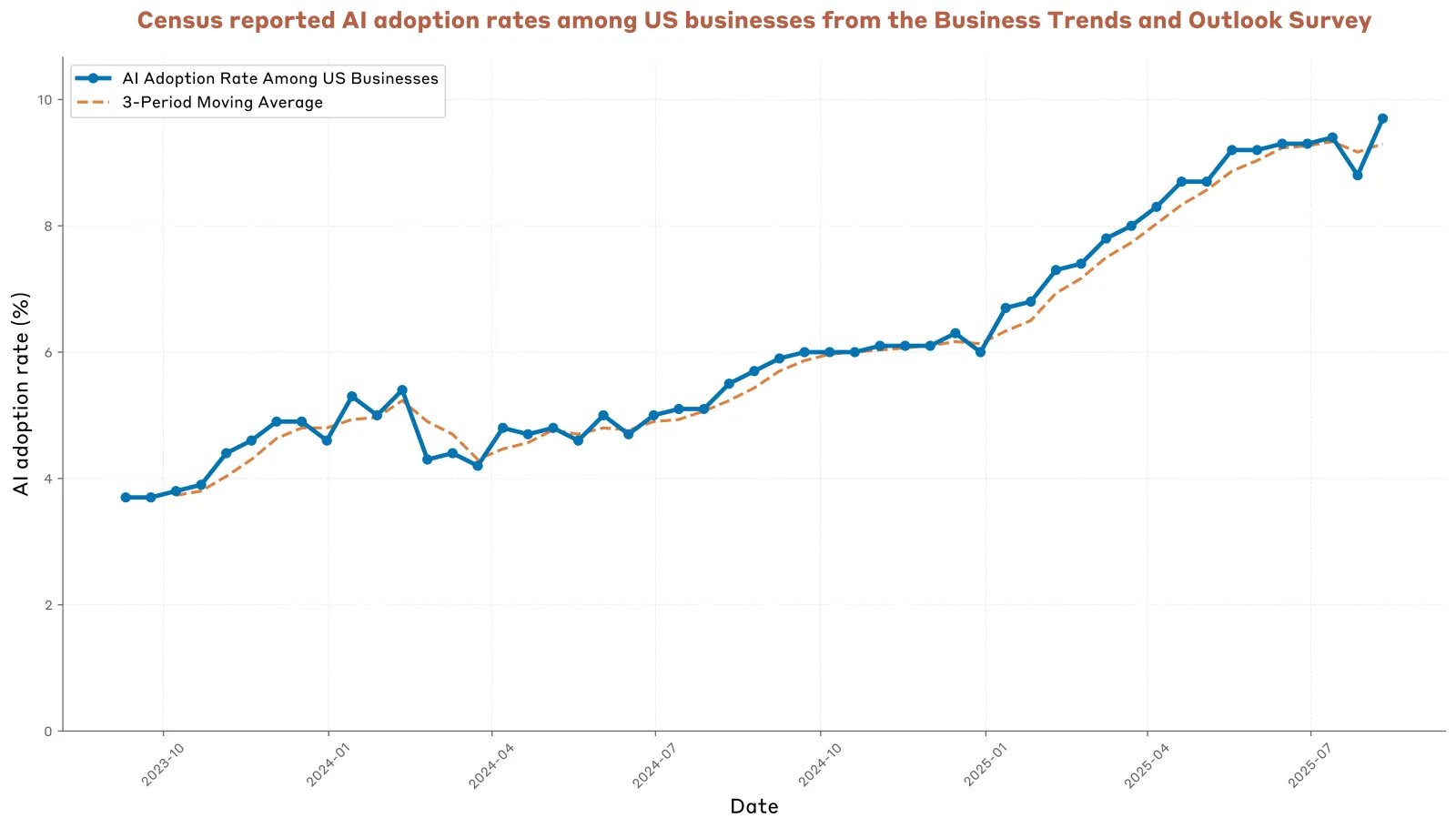
The headline numbers on AI adoption are almost always misleading. Not because they're wrong, but because they're measuring the wrong thing.
Take the UK. A 2024 survey by the British Chambers of Commerce reported that 54% of UK SMEs were "actively adopting" AI. That sounds like serious progress. But the same research found that 95% of those businesses said AI had zero impact on their workforce size, and 86% reported that job roles had remained completely unchanged.
If AI were being deployed for real operational transformation (autonomous quoting, predictive scheduling, intelligent handoffs) you'd expect some measurable shift in how work gets done. The lack of any workforce impact is the tell. That 54% figure is mostly employees using generative AI to draft emails. The firm hasn't changed at all.
When you use more rigorous instruments (the UK's ONS Business Insights and Conditions Survey rather than a commercial poll) the picture is different. The ONS found that only 23% of UK businesses were using any form of AI by late 2025. Independent analysis puts true operational adoption, AI actually embedded in core business processes, closer to 15%. That leaves roughly 5.5 million UK SMEs operating without advanced digital capabilities.
Three different surveys. Three very different answers.
The number depends entirely on how you ask the question.
The same pattern plays out across Europe. Eurostat data for 2025 shows that 55% of large EU enterprises were using at least one AI technology. For small businesses, that figure drops to 17%. And among EU small businesses not using AI, only 13% had even considered adopting it. This isn't a technology problem. It's a case-hasn't-been-made problem.
The firm-size chasm in Europe
Same continent, same technology, same tools available. Very different realities.
It's a K-shaped economy, and most SMEs don't know which curve they're on
Here's the thing about a productivity gap. It doesn't feel catastrophic the day it opens. It feels fine.
You're still winning deals. Margins are holding. The team is working hard. Nothing about the day-to-day suggests anything is wrong.
But your competitor has been quietly pulling away. The one who started automating quote generation 18 months ago, who built a voice-to-CRM flow for their field reps, who stopped manually reconciling the sales-to-ops handoff. That company is doing the same revenue with fewer people. Their cost per order is falling. Their reps have more selling time because the admin isn't eating their week. They quote faster. They win deals you don't even know you're competing for.
OECD data shows that AI-enabled productivity in manufacturing and logistics is growing at 2.8–3.2% annually in Europe and the US for companies that have adopted it. That compounds. Over five years, a company capturing that growth is in a fundamentally different cost structure than a company that isn't. It's not an incremental gap. It's structural.
"The cost of inaction isn't a theoretical risk. It's a real number, already accumulating. The fuse is just longer than most people expect."
What the productivity gap looks like over 3 years
Why SMEs aren't starting, and why "we can't afford it" is only half the story
The obvious answer to why SMEs aren't adopting AI is cost. And cost is real. Enterprise AI infrastructure is genuinely expensive to build and maintain. Manufacturing SMEs in particular face the additional burden of retrofitting legacy machinery with IoT sensors before they can even generate the data that AI needs to work on. Many run on equipment that's decades old and has no digital interfaces at all.
But the research points to something more specific and more fixable. In the UK, 67% of SMEs cite a lack of internal expertise as the primary barrier. Not the cost of the technology itself, but the absence of anyone who knows how to apply it. UK AI talent is almost entirely absorbed by financial services in London, large multinationals, and well-funded AI startups. A manufacturer in the Midlands simply cannot compete for that talent on salary alone.
In the EU, the regulatory environment adds another layer. The EU AI Act has created a genuine chilling effect. Over half of EU enterprises that considered but ultimately rejected AI adoption cited a lack of clarity around legal consequences as a primary reason. Non-compliance fines of up to €35 million or 7% of annual turnover are existential for a small business. So rather than risk misinterpreting compliance requirements, many have simply stopped exploring.
In logistics specifically, the ROI problem is acute. Research shows that over 85% of UK logistics companies want to invest in digital technologies, but cannot confidently predict a return. And here's the structural reason why: the biggest economic benefits of AI in logistics (network-wide route optimisation, dynamic pricing, predictive load balancing) are only realised at scale. For an SME operating ten delivery vehicles, the marginal gain from a complex routing algorithm probably never offsets the cost of the software, the hardware, and the training. The economics only work for them if the tool is designed for their scale, not bolted down from an enterprise contract.
And then there's the J-curve problem. It's perhaps the most underappreciated reason AI projects fail. When you introduce a system that disrupts existing processes, productivity almost always dips before it rises. The team is learning. The workflow is being rebuilt. Results take time. Most SMEs don't have the financial runway to survive that dip, so they abandon the project before the curve turns upward and conclude that "AI doesn't work for us."
Why SMEs aren't adopting: what the research actually shows
These aren't irrational fears. They're rational responses to a genuinely difficult integration environment.
The failure mode I see most: bad targeting, not bad technology
Companies that do try AI often fail in a specific and avoidable way. They don't start with a real problem. They start with a tool.
"We should get an AI chatbot for the website." Why? "Because everyone has one now." That's not a use case. That's decoration. It doesn't solve anything, it doesn't save anyone's time, and when it delivers no ROI (which it won't, because it was never pointed at a real problem) it becomes the reason the company decides AI "doesn't work for us."
Anthropic's research found that early enterprise deployment is heavily concentrated in tasks where model capabilities are strong, deployment is straightforward, and the economic value of automating that specific task is clear. The companies seeing returns started with a specific, expensive, recurring problem. Not "how do we use AI?" but "what task is creating the most drag, and can AI fix it?"
For a field sales team, that task is usually one of three things: CRM logging they never do properly, quote turnaround that takes days when it should take hours, or the post-meeting admin that eats the end of every rep's day. None of those require a transformation programme. They require a well-scoped piece of work that fixes one specific thing and proves the number.
Why one consistently fails and one consistently works
❌ The hype path
✓ The problem-first path
What the research says about where this is heading
Anthropic's labour market research found that workers in the most AI-exposed occupations are more likely to be older, more educated, and higher-paid. These aren't low-skill jobs at risk. These are knowledge workers, the expensive people I mentioned at the start.
They also found no systematic increase in unemployment for those workers yet. AI is not causing mass unemployment. The people doing those jobs are largely still doing them.
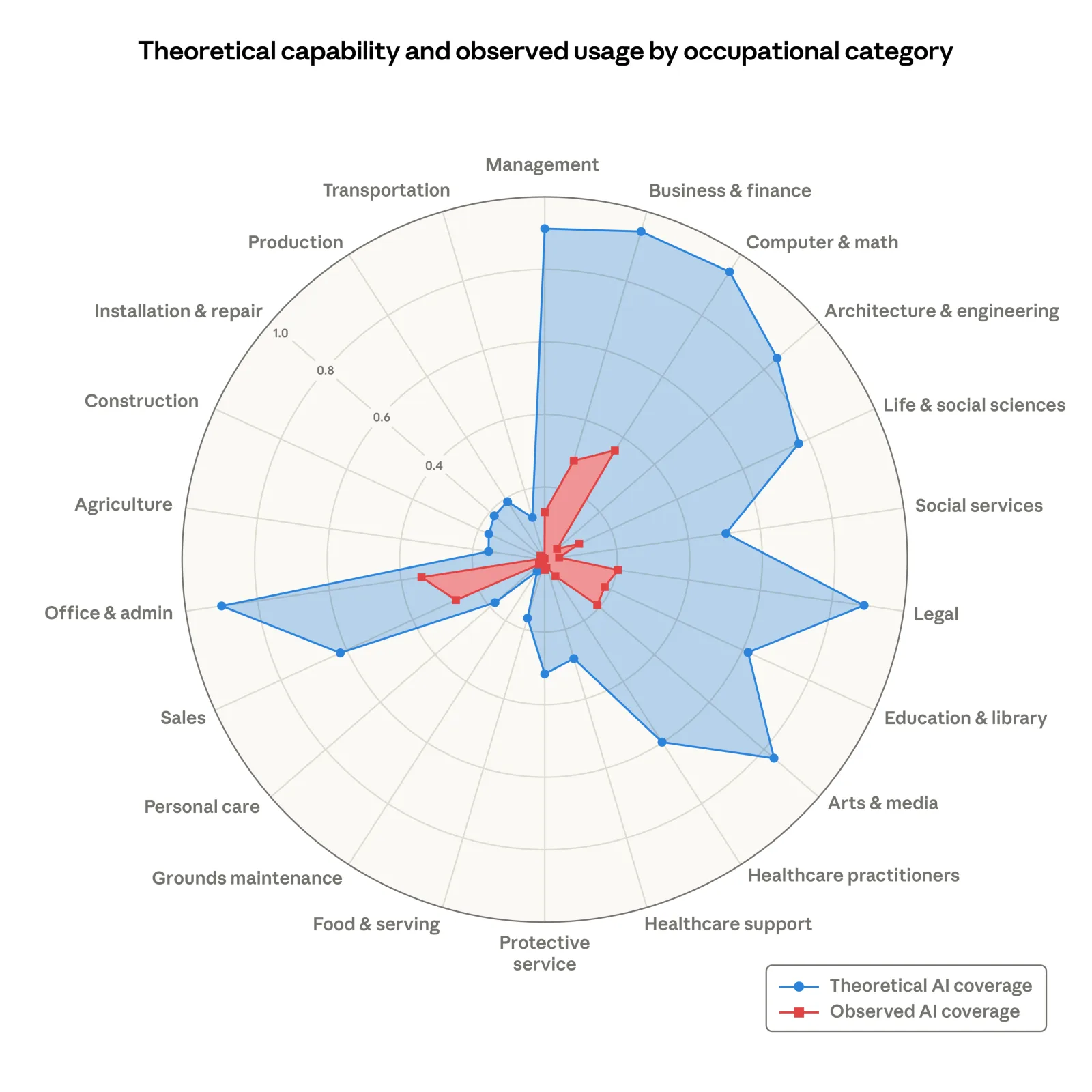
But there's a more subtle finding that matters more for the businesses I work with. There's suggestive evidence that hiring of younger workers has slowed in exposed occupations. Companies are getting the same output from existing senior staff, partly because AI is handling tasks that used to be entry-level work. They're not laying anyone off. They're just not backfilling when someone leaves.
Over time, this is how the hollow middle forms. Not through mass layoffs. Through the compounding efficiency of one set of businesses over another, until the cost structure divergence becomes impossible to overcome. The OECD describes this trajectory directly: without targeted intervention, the AI adoption gap risks creating an economy with hyper-efficient large enterprises at one end, hyper-local micro-businesses at the other, and the mid-market (UK manufacturing, logistics networks, regional distributors) squeezed out in between.
What I actually believe, having seen both sides
AI is not going to save businesses that aren't performing. Nothing does that. What it will do is amplify what's already working.
A field sales team that's good at selling will get better. Our 27 statistics on admin waste in UK field sales show exactly where the time goes. A quoting process that's almost right will get there. A commercial director who's drowning in admin will get their head above water and start operating at the level they were hired for.
The businesses that get the most from AI start with an honest audit of where their best people's time is going. Not "how do we use AI?" but "what is eating the capacity of people we're paying serious money to think, sell, and decide?"
Answer that question and the use case becomes obvious. You don't need a roadmap or a transformation programme. You need to fix one thing, prove it works, and build from there. That's it.
The gap between the call and the high street is real. It's growing. And the longer it stays open, the harder it becomes to close. Not because the technology gets more complicated, but because the compounding advantage of the companies on the right side of it gets harder to overcome.
Most SMEs don't need a transformation. They need to find the one task that's costing them the most and do something about it. That part is still simple.
For the data behind where UK adoption actually sits versus the survey headlines, see 54% of UK SMEs Use AI. The Real Number Is Closer to 15%.
Not sure where to start?
I work with mid-market companies in manufacturing, logistics, and construction to find the AI use cases that actually move the needle, and build them. The first conversation is always about your specific situation, not a generic pitch.
Book a 30-minute call →Related reading
AI for Distribution Companies: A Practical Guide for UK Wholesalers
Same trucks. Same drivers. 25% more deliveries. That's what SIG Plc got from AI-driven route optimisation. A practical guide to the three highest-value AI applications for UK distribution and wholesale companies with 50-250 staff.
UK Field Force Automation Market 2026: The £127M Figure Nobody Agrees On
Nine research houses price the UK field force automation market between £127M and £216M, disagreeing by 76% on size. Why the gap exists, and what to do.
Why 70% of AI Projects Fail — And What the 30% Do Differently
Bain 2025: without process redesign, companies automate inefficiencies instead of removing them. If your quoting process is broken, AI quotes broken faster. Why 70% of AI projects fail and the five patterns that explain it.
Why the UK Field Sales Business Model Is Breaking (And How to Fix It)
Field sales companies across UK manufacturing, construction, and logistics are quietly breaking. Not failing — just getting more expensive every year. The 62% admin tax, the hiring trap, and the three gaps throttling revenue.